
5 Characteristics of an Effective Instructional Coach
Key takeaways
Coaches who demonstrate these five characteristics can transform instructional coaching from a compliance activity to a driver of meaningful growth:
- Observe with an objective lens
- Cultivate trusting relationships
- Center teacher voice
- Build reflective capacity
- Champion high expectations for students
Read on for a closer look at each coaching characteristic—including practical strategies and example coaching stems your team can use right away.
This is part 1 of a series on instructional coaching. Subscribe to our mailing list to have the latest blogs and resources delivered straight to your inbox.
What is the role of an instructional coach?
Instructional coaches provide teachers with individualized feedback and support that strengthens their knowledge, skills, and actions to improve instruction and better meet their students’ needs.
Often, instructional coaching is not an evaluative or direct supervisory role—coaches act as trusted partners, working alongside teachers to refine their teaching practice and help all students succeed with grade-level content.
Exactly who fills this role depends on your context. This work might be filled by a dedicated coaching position, or carried out by teacher leaders, school administrators, or district-level content leaders. Whoever takes on this work, what matters most is that the support is relational, content-specific, and responsive to teachers’ and students’ evolving needs.
Characteristics of an effective instructional coach
In our work with schools and districts across the country, we’ve found that effective instructional coaches share a set of characteristics that help teachers internalize feedback and grow:
1) They observe with an objective lens.
Effective coaching begins with sharpening the observer’s lens to ensure feedback is rooted in objective evidence rather than personal preference. As a coach observing instruction, the goal isn’t to decide if you liked a lesson, but to understand if it met the demands of the standards and the needs of the students. Cultivating an objective lens helps coaches earn teachers’ trust and provide feedback on what students actually need.
Practical strategies for minimizing preference while observing instruction:
- Reflect on personal biases: Identify the personal and pedagogical preferences that can unintentionally cloud judgment. A coach can ask themselves:
- What “story” have I already written about this teacher based on past experiences? Am I looking for evidence to support that story, or am I open to being surprised by growth?
- What are my own preferences for teaching styles that might unfairly color my entire impression of a lesson (e.g., quiet vs. loud classrooms)?
- Keep it concrete: Use a standardized classroom observation rubric focused on specific teaching behaviors and student outcomes. Take low-inference notes based on objective evidence during observations (e.g., student work, interactions, engagement levels) to avoid relying on gut feelings to score the rubric.
- Seek multiple perspectives: Balance out individual preferences by regularly observing classrooms with other leaders, discussing interpretations of classroom practices, and calibrating your rubric scores.
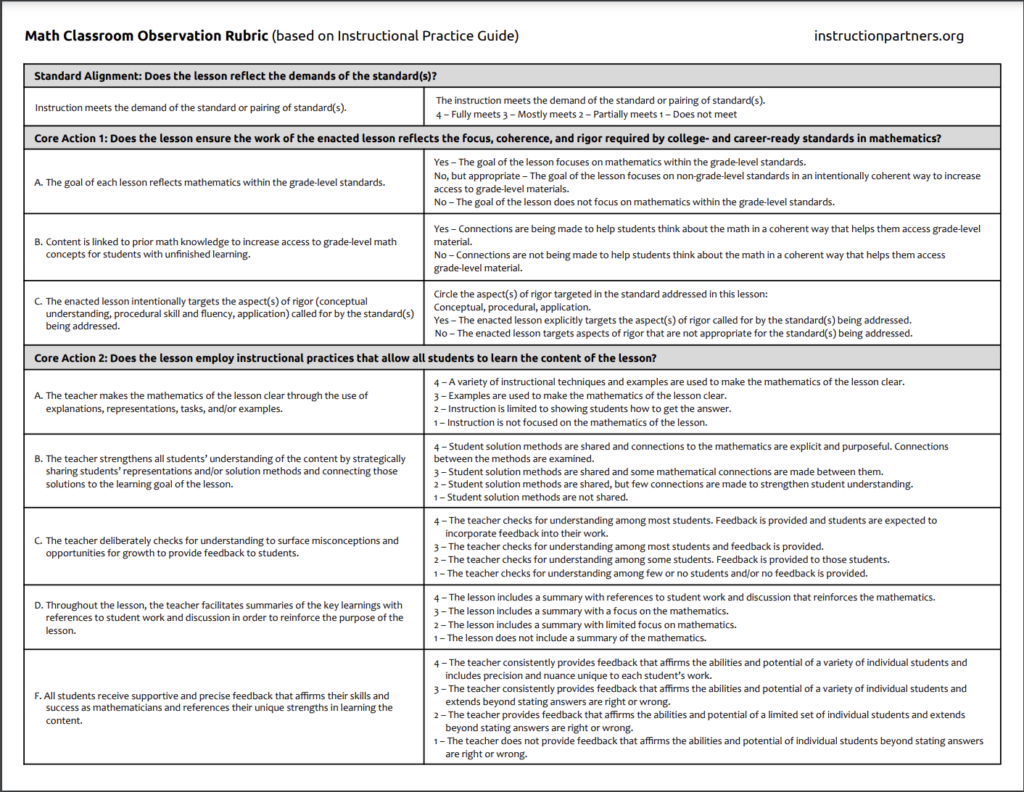
Download our free classroom observation tools
The Instructional Practice Guides are classroom observation tools that describe “core actions” associated with standards-aligned content, effective teaching, and meaningful student engagement in ELA, reading foundational skills, math, and science. Each core action includes indicators and a rating scale, making it easy to identify trends across classrooms and track progress over time.
more
2) They cultivate trusting relationships.
Impactful coaching requires trust. For teachers to grow, they must feel comfortable enough to ask questions, share challenges, internalize feedback, and try new things.
To cultivate trusting relationships, effective instructional coaches recognize the pressures teachers are under, celebrate their wins, and create a space where they can safely share both successes and struggles.
Practical strategies for cultivating trusting relationships:
- Prioritize the person: Ensure teachers feel seen, heard, and valued. Start meetings with friendly conversation rather than diving straight into data or practice.
- Example: “How are things going for you this week, both in and out of the classroom?”
- State the purpose: At the start of a coaching session, briefly remind the teacher that the purpose is growth and student success, not judgment.
- Example: “My goal today is to help you reflect on what went well and identify one powerful focus area to make your next lesson even stronger for students.”
- Name the wins: Before providing corrective feedback, begin with a specific, positive observation that is evidence-based.
- Example: “I noticed how you used the timer to manage transitions, which kept a great flow.”
- Reaffirm commitment: End meetings by reaffirming commitment to the teacher’s growth.
- Example: “Thank you for being so open to this discussion. I’m excited to see the impact of this change on your students.”
3) They center teacher voice.
Coaching meetings shouldn’t feel like lectures. While the coach facilitates, the teacher should be the primary thinker and speaker—identifying opportunities for implementation, naming next steps, and capturing notes.
Practical strategies for centering teacher voice:
- Start with the teacher: Ask the teacher to share their impressions from the lesson first.
- Example: “Before I share what I noticed, what’s a moment from the lesson you feel went particularly well?”
- Share the cognitive lift: Shift the mental heavy lifting to the teacher so they are the primary architects of their own growth. (The role of an instructional coach is more about asking the right questions, which we’ll dig into in the next characteristic.)
- Name the next steps together: Guide the teacher to articulate their next steps after the session.
- Example: “Based on what we’ve discussed, what is the one thing you will focus on implementing in your planning/delivery this week to move student learning forward?“
4) They build teachers’ reflective capacity.
As an instructional coach, your goal is to support teachers in leading their own growth. During coaching meetings, it’s important to ask skillful questions that guide teachers to strong reflection and clear next steps.
Practical strategies for building teachers’ reflective capacity:
- Self reflect: Ask yourself whether you are asking “checkmate” questions (trapping teachers into your pre-determined answer) or generative questions (inviting them to explore their own impact).
- Ask open-ended questions: Use broad, open-ended questions.
- Examples:
- What are you most proud of from that lesson?”
- “If you could teach it again right now, what’s one thing you would adjust?”
- Examples:
- Ask probing questions: Use your observation notes to guide the discussion without lecturing.
- Examples:
- “Tell me more about the moment when [Student X] seemed confused. What were you hoping to achieve with that activity?”
- “I noticed only three students participated in the discussion; what’s your theory about how to get broader engagement next time?”
- Examples:
Here are some additional coaching stem examples you can use to prompt deeper reflection:
- Looking at this evidence, what’s a pattern you’re noticing?
- What do you think was the biggest strength of the lesson today?
- How do you think you could build on that strength in your next lesson?
- During your lesson, I heard/saw ____. How is that the same or different from the suggested approach of the curriculum?
- What do you think held you back from doing _____?
- What’s your sense of what’s making this part of the lesson so difficult for students?
- If you were to [more effective practice], what do you think would be different for your students?
5) They champion high expectations for students.
An instructional coach is tasked with improving instruction for every student in the building. This requires consistently viewing lessons through the lens of all student groups, ensuring high-quality education is accessible to everyone.
It’s important to remember (and remind teachers) that students take cues about their potential as learners from their teacher’s actions and words. Effective coaches challenge deficit-based mindsets about what students can achieve—and partner with teachers to find solutions that empower every learner to succeed with grade-level content.
Practical strategies for championing high expectations for students:
- Ask specific questions: Prompt reflection on specific student groups with intentional questions.
- Example: “How did this lesson specifically support your English language learners?”
- Address deficit mindsets: If the teacher uses language that blames students or their background for lack of success with the material, address it directly but compassionately and keep the conversation focused on solutions.
- Example: “I hear your frustration, but my job is to help you find an instructional strategy that reaches every student. Let’s reframe: If you assume all students can and want to learn, what’s a different way to structure that activity?”
We’ve seen firsthand that when coaches bring these characteristics to their work, they can have an outsized impact on school culture, instructional quality, and student learning.
Looking for more coaching support?
Download our full suite of observation and feedback resources for action plans, guiding questions, and templates to improve feedback for your teachers.