
5 Strategies to Build Teacher Buy-in for PLCs
When there is genuine teacher buy-in for professional learning communities (PLCs), they’re a powerful way to provide teachers with ongoing support, continually strengthen instruction, and improve student learning outcomes.
Yet in our work with schools across the country, the Instruction Partners team often hears from teachers that PLCs feel like just “one more thing” on their already full plates. When teachers don’t see a clear connection to their daily instruction or their students’ needs, PLC sessions become nothing more than a compliance exercise.
The five strategies below can help you shift that perception to build meaningful teacher investment and plan more effective PLCs.
1. Build strong relationships.
Teachers need to know that the person leading their PLC truly sees them, hears them, and values their experience. That means recognizing the pressures they’re under, celebrating their wins, and creating a space where they can safely share both successes and struggles.
Put it into practice
To put relationship-building into practice, I like to reference Search Institute’s Framework for Developmental Relationships. They name five key elements of strong relationships:
- Express care: Show that I matter to you.
- Challenge growth: Push me to keep getting better.
- Provide support: Help me complete tasks and achieve goals.
- Share power: Treat me with respect and give me a say.
- Expand possibilities: Connect me with people and places that broaden my world.
While each of these elements matters, shared power is especially important to building investment. When teachers know their expertise is valued and they have a real voice in PLC decisions, they’re far more likely to engage deeply.
You can start by working with your teachers to create norms for how participants should interact during PLC meetings—clarifying expectations for behavior, communication, and decision-making. This process could look like:
- The facilitator team meets to draft meeting norms grounded in the Search Institute framework’s core concepts. They brainstorm concrete examples of what each norm looks like in action within a collaborative learning space.
- Facilitators gather feedback from their teacher teams on the draft norms and examples.
- After incorporating teacher feedback, facilitators share the new norms with all PLC participants and refer to them at the start of each session.
I’ve found that norms are most useful when they are concrete. Instead of something vague like, “Respect each other’s ideas,” a stronger norm would be, “Listen without interrupting.” Instead of, “Assume the best,” I would suggest, “Ask clarifying questions before assuming intent.”
Fostering strong relationships and setting clear expectations for interactions during collaborative learning will help transform PLCs into spaces where teachers are willing to share their challenges and practice trying new strategies.
2. Set a clear vision.
Conducting PLCs without a clear vision for the time is like sending your team on a road trip without a map—you know you’re moving, you know you want to get somewhere, but no one’s quite sure how they’re meant to get there.
When there is no shared purpose for PLCs, we see a number of common challenges:
- The connection to schoolwide priorities is unclear, leaving teachers unable to see how their efforts impact broader school goals.
- Teachers don’t see how PLCs connect to what’s happening in their classrooms.
- There are no progress monitoring routines, resulting in a lack of meaningful feedback for both teachers and facilitators.
Put it into practice
Create a vision statement that sets a clear aspiration and purpose for collaborative learning, aligned to the school’s overall instructional vision and strategy.
Your vision statement should:
- Be informed by stakeholders from across the community (teachers, coaches, instructional leaders, etc.).
- Be clearly communicated in a variety of ways.
- Help teachers understand how PLCs connect to classroom practice.
- Guide every PLC decision, from who leads it and how often sessions are held to how progress is tracked.
This gives leaders and teachers a common language and helps build a cohesive learning community where everyone is moving in the same direction: toward stronger instruction and better outcomes for students.
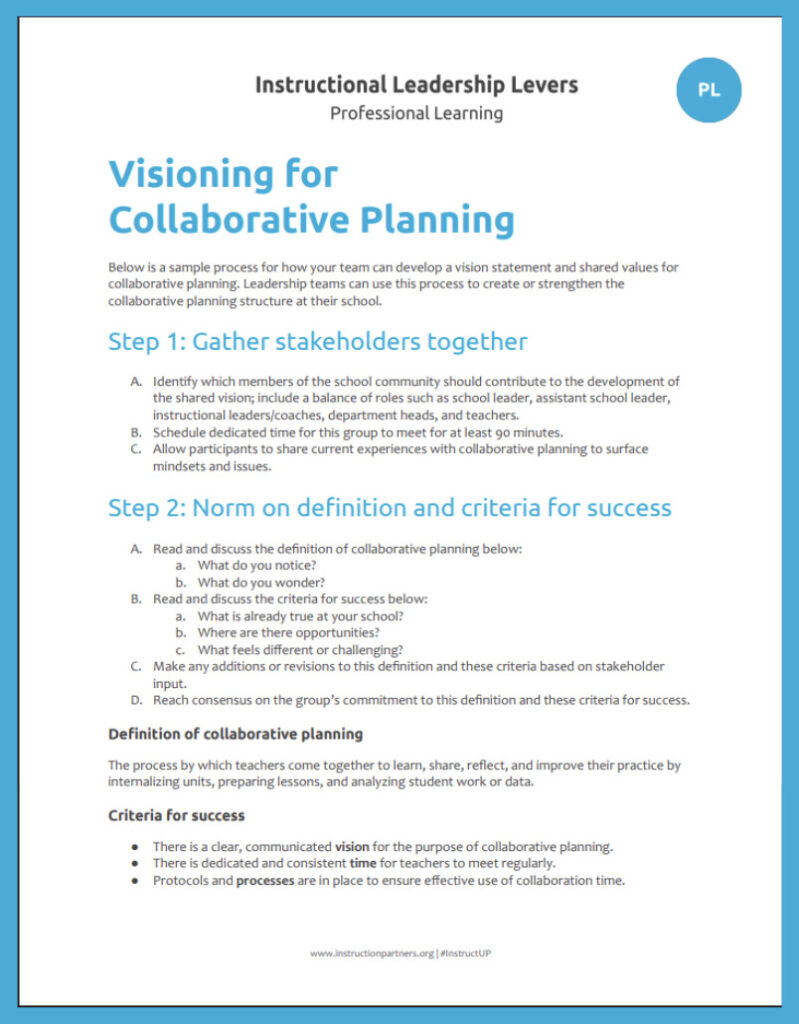
Featured resource
Check out this sample process for how your team can develop a vision statement for collaborative planning.
3. Prepare your PLC facilitators.
Even the strongest vision won’t go anywhere if the PLC facilitator isn’t prepared to carry it forward. Facilitators guide the conversation and connect the dots between the PLC and the classroom. Without adequate time for preparation, they will be ill-equipped to lead deep learning that addresses teachers’ specific needs or challenges.
Consider this example:
A school community selects and adopts a new math curriculum. Teachers complete training over the summer and are excited to start using the materials with students.
However, upon returning to school, they find themselves navigating weekly planning protocols that don’t use the same language as the curriculum, while receiving feedback from leaders that is at odds with the curriculum’s intended design.
Unfortunately, we often see this type of scenario when leaders aren’t fully engaged in the curriculum implementation process, or when facilitators haven’t been trained on the materials. This leads to conflicting messages and a growing sense of frustration for teachers.
Put it into practice
I encourage instructional leaders to embrace their role as “lead learners.”
Teachers want to know that their leaders understand the work that they’re doing and know how to support them in that work. As a starting place, I recommend that instructional leaders complete a curriculum study to better understand how to tailor teachers’ professional learning and feedback routines to the instructional materials.
Additionally, facilitators need ample time to prepare for each PLC session.
For example, before a PLC meeting focused on lesson preparation, an instructional coach can:
- Review the lesson to identify components that might require new or challenging instructional moves.
- Anticipate possible questions and misconceptions.
- Prepare opportunities for teachers to practice these moves.
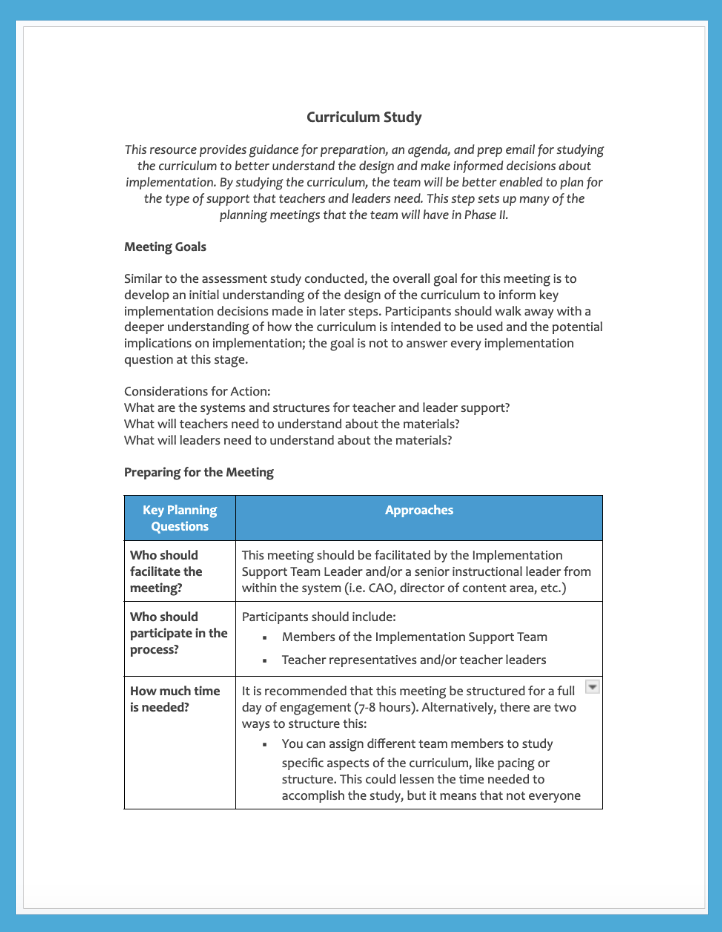
Featured resource
This resource presents a step-by-step process for studying the design of a curriculum, including a sample agenda you can adapt for your team.
4. Track and celebrate teachers’ progress.
Without follow-up, PLCs lose momentum—and teachers lose trust in the process. Tracking and celebrating progress ensures that teachers have the time, guidance, and support to master new practices before being asked to move on to something else.
Progress monitoring routines also help clarify the PLC process and gain insight into how best to support teachers in implementing new skills.
Put it into practice
PLC facilitators need to be able to answer two key questions:
- Are the practices we introduced in PLCs actually showing up in classrooms, or do teachers still need more support?
- What impact is this work having on students’ learning experiences?
The best way to answer both questions is through regular classroom observations. Observations give you real-time insights that enable timely, targeted support. This shows teachers their efforts are seen and valued, and it keeps the work moving forward.
Set up consistent classroom observation routines to:
- Collect empirical evidence of teaching and learning connected to what teachers are working on in PLCs.
- Provide targeted feedback for teachers—celebrating wins and providing actionable suggestions for improvement.
- Identify trends across classrooms to inform future support.
These routines will help create a strong through-line from professional learning to classroom practice to student outcomes.
5. Reflect and refine.
Building teacher buy-in for PLCs isn’t just a “set it and forget it.” It’s important to regularly check in, listen to feedback, and make smart adjustments along the way.
When leaders model this type of reflection and continuous improvement, it shows teachers that PLCs aren’t just a rigid structure, but an evolving process meant to adapt to their shifting needs and get better over time.
Put it into practice
At your next PLC meeting, it’s worth pausing for a quick debrief with teachers:
- What was useful?
- What didn’t land?
- What can we tweak for next time?
This quick feedback lets you make small tweaks right away, showing teachers that their voices matter in shaping the work.
Later this school year, after you’ve had time to take the steps outlined above, you can administer a survey with teachers to assess:
- Which norms are being followed and which need more support?
- How well is the vision understood?
- How clearly does the PLC content connect to classroom practice?
These reflections give leaders the insights they need to refine, build trust, and keep PLCs relevant and meaningful.
Teacher buy-in for PLCs isn’t something that happens overnight—it requires trust, shared purpose, and opportunities to celebrate progress, reflect, and refine. But taking the time to foster genuine investment can lead to more effective PLCs, stronger instruction in every classroom, and better outcomes for every student.
Looking for more professional learning support?
Download our full suite of collaborative planning resources for action plans, guiding questions, and templates to improve PLCs for your teachers.