
Scaffolding (Without Overscaffolding) for Multilingual Learners in ELA
Companion resource
Download our free guide, Scaffolding UP for Multilingual Learners: A Guide to Responsive, Integrated Literacy and Language Learning, to put the strategies explored below into practice.
Finding the balance: Scaffolding (without overscaffolding) for multilingual learners
Multilingualism comes with a host of advantages, including additional lenses that can deepen students’ learning and enrich their perspectives. However, for students who’ve not yet achieved full English proficiency, schooling can present some unique challenges: mastering rigorous, grade-level content while learning to speak, understand, read, and write in a new language.
This challenge, in turn, creates a balancing act for educators: they must provide enough scaffolding to unlock content and language development without overscaffolding—providing too much support and, inadvertently, robbing multilingual learners (MLs) of the opportunity to engage in deep thinking.
In this blog post, we explore how to avoid the trap of overscaffolding and ensure the supports you’re providing to MLs are dynamic, responsive, and—most importantly—actually help students develop deeper content knowledge and advanced language skills.
Overscaffolding
Overscaffolding occurs when support becomes excessive (e.g., deeper support than is necessary, support that is too long-lasting). When we over-support, we unintentionally remove the productive struggle that students need to learn—and get in the way of their success.
In our experience, the tricky thing about overscaffolding is that it comes from a place of care—of truly wanting to do everything in one’s power to help students succeed. However, it’s often the result of unrecognized lowered expectations for what MLs can do. Research shows that many educators assign MLs who have beginning English proficiency less challenging work than other students. However, even when MLs haven’t yet achieved full English proficiency, as we wrote back in 2023, “that doesn’t mean that they are any less capable of mastering grade-level content—if their teachers and administrators understand their linguistic development journey and are able to scaffold the right supports at the right time.”
How do you know if scaffolds are preventing students from developing independence? Look for these red flags:
- Limiting student thinking: If the teacher is doing most of the talking or thinking, that’s a good indication that they’re overscaffolding. This might look like:After reading a text, the teacher immediately explains what they just read, rather than prompting students to make connections or inferences themselves.The teacher provides answers to questions directly, so all students have to do is copy or repeat them, rather than demonstrate understanding on their own.The teacher “rounds up” responses—that is, when a student gives a partial answer, the teacher finishes the thought or makes a connection for them, instead of pushing the student to give more details (e.g., “And what does that have to do with ___”?). The student misses the chance to build their own academic language and share their higher-level thinking.
- Oversupporting: The teacher uses high-intensity supports (e.g., think-alouds, modeled responses) when lighter supports (e.g., sentence stems) would suffice.
- Overtranslating: The teacher heavily translates texts or tasks, inadvertently removing the “productive struggle” required to develop English proficiency. Home language support is a powerful tool; however, overusing translation can create a “translation dependency” where the student “tunes out” English because they know the version they already understand is coming. This could look like the teacher translating every vocabulary word instead of using multimodal supports (e.g., visuals, gestures, real objects) and using translation for more difficult concepts such as abstract nouns.
- Excessive frontloading: The teacher spends an excessive amount of time frontloading background knowledge or pre-teaching vocabulary in isolation rather than allowing students to encounter and make meaning of words within the context of the text. Though previewing vocabulary can be an effective strategy in moderation, when overused it can minimize—or even outright eliminate—the need for students to make sense of a text themselves, which is a necessary component of most grade-level standards.
Responsive scaffolding
Responsive scaffolding is about enhancing access and comprehension for all students. This includes identifying specific barriers—whether they are linguistic, conceptual, or related to cultural background knowledge a lesson assumes students bring. It isn’t about making the work easier; it’s about providing the right tools so the student can do the heavy lifting. (One way to think about responsive scaffolding is through the lens of “Universal Design for Learning” principles [CAST], which focuses on varying access points to help all students work toward increasing rigor— not by simplifying the goal.)
During lesson internalization, teachers need to deeply think through the content and language demands of the specific lesson they’ll be teaching (e.g., what texts, tasks, concepts, or language might be especially complex or challenging for which students?). Then—and this is the part that too often gets overlooked—they should think through the assets students already have that could help them overcome identified barriers (e.g., a tradition of family story telling could support literacy development, familiarity with the metric system could help students learn the imperial system).
Only then, after considering both the challenges students may face and the knowledge and skills they already have, can a teacher effectively plan out what scaffolds will be most appropriate. For multilingual learners (MLs), productive scaffolding often means making language visible and explicit. Making the implicit structures of communication (e.g., vocabulary, sentence structure, and text organization) explicit both 1) makes learning those structures much more effective and 2) helps MLs connect with the content being communicated because they’re not doing double duty trying to intuit the structures.^ This can look like:
- Leveraging home languages:
- Encourage translanguaging (i.e., using all the languages a student knows) to brainstorm or discuss concepts before speaking or writing in English.
- Share cognates—words that look and sound similar across languages—to help students make immediate meaning of new vocabulary.
Note: Using home languages can also be a helpful strategy to use with students who may speak a variety of English at home (e.g., Cajun English) that has a set of vocabulary and grammatical rules that differ from Standard American English.
- Providing targeted language supports:
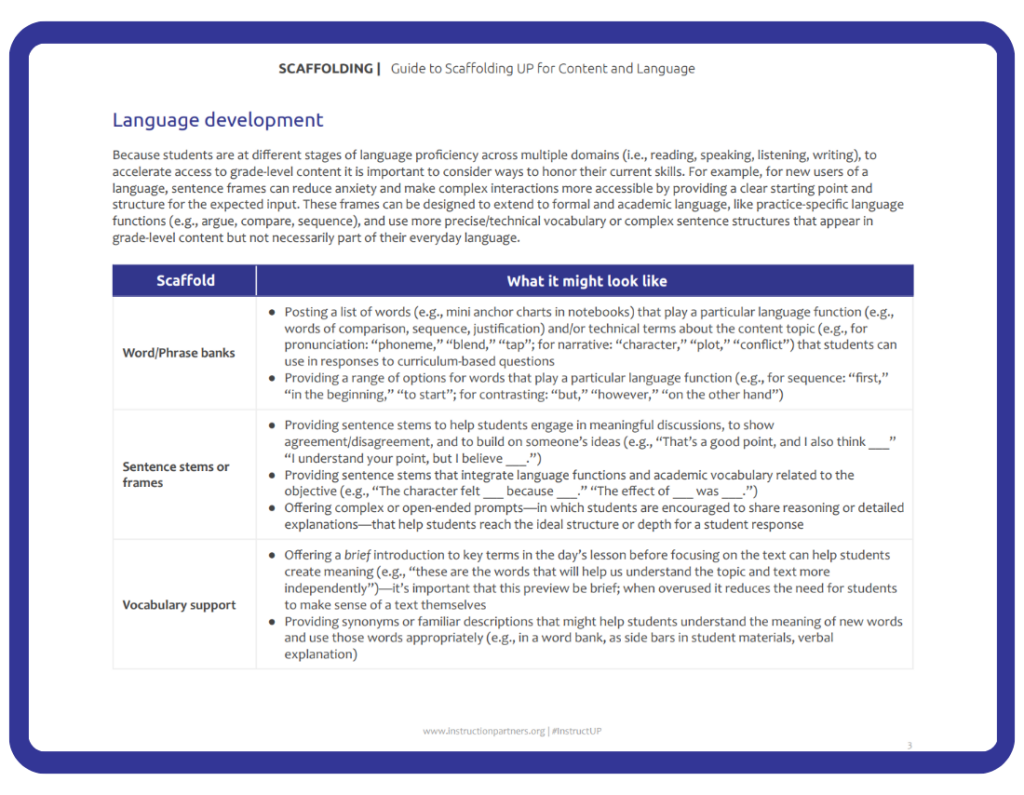
- Use word or phrase banks for terms that serve particular functions that students can use in responses to curriculum-based questions. For example:
- words of comparison, sequence, or justification
- words related to content topics
- for pronunciation: “phoneme,” “blend,” “tap”;
- for narrative: “character,” “plot,” “conflict”
- Provide sentence stems that integrate language functions and academic vocabulary related to the objective (e.g., “The character felt ___ because ___.” “The effect of ___ was ___.”)
- Use word or phrase banks for terms that serve particular functions that students can use in responses to curriculum-based questions. For example:
Note: These kinds of support can help students focus on articulating their conceptual understanding rather than the structure of explaining their thoughts.
- Using multimodal supports:
- Provide graphic supports that help students organize their thoughts linguistically, such as
- co-created anchor charts that include unit key vocabulary or facts
- graphic organizers for plot or summary that students can complete while or after reading a text
- Explicitly model how to use multimodal supports; for example, rather than just handing students a tool, like a graphic organizer, explain to them:
- What the support is: “This is a concept map.”
- Why it is being provided: “We are using this to organize the causes and effects of the Revolutionary War.”
- How to use it effectively: “First, put the main idea here. Next, find three supporting details…”
- Use sensory and visual means to reinforce key content, for example:
- Show visuals to illustrate a concept during a read-aloud
- Pass around objects related to the text’s topic (e.g., seashells or a jar of sand for a story about visiting the beach)
- Showing a short (e.g., 45-second) clip at the beginning of a lesson that builds on students’ background knowledge about the text’s topic, embedding supports within videos to highlight key information or language as needed.
- Provide graphic supports that help students organize their thoughts linguistically, such as
Note: Multimodal supports reinforce language learning for all students, not just MLs, by connecting new words and structures to images, actions, and experiences, making both the concept and the language more understandable and memorable.
- Leveraging personal connections:
- Ask students to make personal connections to the lesson’s topic (e.g., “today we are going to learn about farm animals, have you ever visited a farm?”)
- Refer to prior knowledge, for example, make connections to a topic or skill previously taught (in the same or different unit or grade level)
Note: Like multimodal supports, using personal connections to reinforce new learning helps make content stickier for all students.
The examples above are for learning English, but these concepts/practices could be used with another language of instruction in a dual language program.
^ See John Hattie’s work for more visible learning for literacy.
A Guide to Responsive, Integrated Content and Language Learning
Our resource, Scaffolding UP for Multilingual Learners, has more examples of each of these types of scaffolds—along with guidance for identifying unproductive overscaffolding and engaging in meaningful coaching conversations.
The goal of any scaffold is to build independence with increasingly cognitively demanding and complex skills and texts, including moving students from their current language proficiency to a more advanced level. To be responsive to student growth needs, educators should consistently monitor how students are using the supports provided. In our experience, we find it’s helpful to consider three broad categories:
- Who is productively struggling (i.e., the support is working)?
- Who is passively completing (i.e., the support is making the work too easy)?
- Who is frustrated or stuck (i.e., the support might be too challenging or just not what they need)?
As MLs begin to internalize content and strategies—that is, move from productively struggling to passively completing—it’s time to adjust the scaffold so the work becomes more linguistically challenging (e.g., moving from a simple “I believe…” stem to “Given the evidence, ___ can be justified by ___”).
Effective scaffolding for MLs is rooted not only in their current level of English proficiency but in understanding the cognitive strengths, cultural funds of knowledge, and prior schooling they’ve had in their home language. By treating scaffolds as a bridge to rigorous, grade-level instruction, we can hold high expectations for MLs, honor the assets they bring to the classroom, and support their learning without falling into the trap of deficit thinking.