
Leadership Strategies for Strengthening Math Fluency
In the first post of this series, Building Math Fluency in Middle School Classrooms, we explored what mathematical fluency is and why it’s such a powerful lever for connecting core instruction and intervention in middle school math.
We hope that the reflection questions, guidance, and examples below can help your team evaluate where teachers may need additional support to strengthen students’ fluency development and guide them toward grade-level mathematics.
Once you’ve identified where to focus your improvement efforts, download our free Middle School Math Fluency Toolkit to access planning resources, instructional routines, and implementation guidance designed to support this work.
5 Questions Instructional Leaders Should Ask About Math Fluency
To what degree are your intervention efforts setting students up for success with grade-level content?
To get a clear picture of where your team is starting from, take a close look at a recent unit for each grade level. Identify the big ideas students are working toward within the unit and the prerequisite skills they’ll need to get there. Then, consider:
- Are the skills and concepts students are practicing in intervention preparing them for the grade-level content
- Are students experiencing similar models, language, and routines across both tiers?
If your school doesn’t have a separate intervention block, it’s especially important to equip teachers with realistic pacing guidance that includes flexible time to reinforce essential learning from prior grades. Consider:
- How and when are students getting support for unfinished learning during core instruction?
- Are teachers intentionally planning activities that build the prerequisite knowledge students need to access priority grade-level content?
Understanding how well core instruction and intervention are connected can help leaders identify where stronger alignment and fluency-building support may be needed across tiers—and prioritize the professional learning and instructional supports explored in the questions below.
What is your team’s familiarity with fluency-building as an instructional strategy?
Instructional leaders and teachers need a strong understanding of how mathematical fluency develops across grade levels. If fluency-building is not already a focus of your math program, leaders and teachers may benefit from dedicated professional learning on how to intentionally support students’ fluency development.
Upfront professional learning can help leaders and teachers build this shared understanding in two key areas:
1) Studying progressions across grades and domains
A strong starting point is studying how visual models and standards progress across domains and grade levels. As teams study these progressions, leaders can guide reflection with questions such as:
- Which domains feel most conceptually demanding and/or reliant on prior learning?
- How does understanding deepen within a domain across grade levels?
- What kinds of visual models have you seen students use in your grade level?
- How do those models evolve across grade levels?
This work can strengthen both Tier 1 and Tier 2 instruction by helping teachers build on students’ existing understanding and create more coherent learning experiences across support settings.
2) Experience fluency-building routines as learners
Professional learning time is also an important opportunity to introduce routines that intentionally build fluency during both core instruction and intervention.
For example, a “connecting representations” routine helps students connect different forms of the same mathematical idea—such as equations, tables, graphs, and verbal descriptions—to strengthen flexible understanding. Students analyze multiple representations of the same concept, discuss the connections they notice, and create additional representations to explain their thinking.
When introducing a new routine, leaders should give teachers opportunities to engage as learners. Experiencing the routine from a student perspective helps teachers better understand how it supports mathematical reasoning, discussion, and flexible thinking.
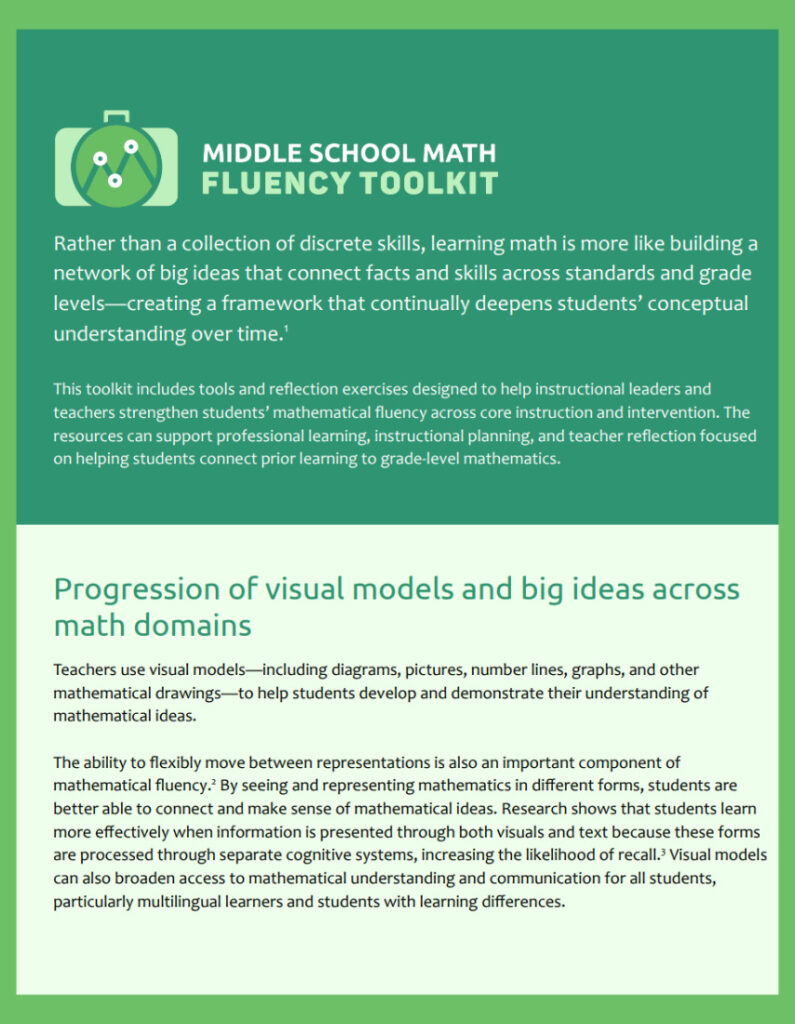
Middle School Math Toolkit
The free Middle School Math Fluency Toolkit includes resources leaders can use to plan professional learning focused on mathematical model progressions and fluency-building instructional routines.
What type of ongoing support is in place for teachers as they implement fluency-building strategies?
Building mathematical fluency requires more than a single professional learning session. Teachers need ongoing opportunities to plan, reflect, and refine their instruction over time.
PLCs can provide the dedicated space teachers need to set clear lesson outcomes, anticipate unfinished learning needs, and plan instruction that builds students’ mathematical fluency across tiers. To effectively support this work, leaders must establish the conditions for strong collaborative planning—including a clear purpose aligned to instructional priorities, protected and consistent planning time, and strong facilitation grounded in the instructional materials.
Does your instructional planning protocol support math fluency development?
Critical instructional decisions should be made at the unit level. By working backward from a unit’s learning goals, teachers identify the lessons, tasks, and concepts that should be prioritized to support student understanding.
Fluency development should be intentionally embedded within the unit internalization process. A shared protocol can help teachers plan for the visual models and academic language that will support students’ fluency development toward the unit’s learning goals.
When creating a protocol, consider schoolwide instructional priorities, teacher needs, the structure of instructional materials, and time constraints to determine which aspects of unit internalization should happen collaboratively vs. independently.
An effective protocol might guide teachers to consider:
- What are the main mathematical concepts students are applying in this unit?
- Which visual models help students understand these concepts?
- Which visual models from previous grade levels could help students connect unfinished learning to grade-level content?
- Where might students need additional scaffolds or opportunities to connect to earlier learning?
What data do you collect to monitor the impact of fluency-building instruction?
Ongoing data collection helps transform fluency-building efforts into sustained instructional practice. By regularly reviewing evidence from planning and instruction, leaders can understand how fluency-building efforts are impacting student learning and identify where teachers may need additional support.
- Teacher planning: Monitor how facilitators and teachers are incorporating fluency-building strategies into planning by observing PLCs and reviewing teachers’ unit internalization annotations.
- Classroom instruction: Monitor the impact of teacher learning on classroom instruction through regular classroom observations. Using a standardized observation rubric focused on specific teaching behaviors and student outcomes can help leaders identify trends across classrooms and track implementation over time.
- Student learning: Monitor the impact of fluency-building instructional strategies by analyzing student work and reviewing student-level data from curriculum-embedded assessments. For example, teams might regularly analyze exit tickets to identify common misconceptions and determine how and when those misunderstandings should be addressed.
Building students’ mathematical fluency requires coordinated professional learning and instructional planning across core instruction and intervention.
We hope these reflection questions help your team prioritize and implement instructional support structures that strengthen students’ fluency development.
Ready to get started?
Download the Middle School Math Fluency Toolkit for planning resources, instructional routines, and implementation guidance designed to help leaders and teachers strengthen fluency development across Tier 1 and Tier 2 instruction.