A Classroom Observation Checklist for Instructional Leaders
Key takeaways
Intentionally preparing for before, during, and after a classroom observation equips leaders to move from simply “scoring” a lesson to leading meaningful instructional coaching that drives growth for teachers and students.
- Before the observation: Preview the lesson to ensure clarity on learning goals, student work, and teacher moves.
- During the observation: Gather various types of evidence of student learning.
- After the observation: Synthesize your observation notes to determine a single, high-leverage action step that a teacher can master quickly.
Read on for a closer look at each phase of the observation process—including practical leadership strategies and guiding questions. Plus, download a printable checklist your team can start using right away.
This is part 2 of a series on instructional coaching. Our first post in this series, 5 Characteristics of an Effective Instructional Coach, explores how coaches can build the trusting relationships teachers need to reflect deeply, share challenges, and try new things. Subscribe to our mailing list to have the next post delivered straight to your inbox.
Classroom observations can be a powerful tool for strengthening teaching and learning across a school building or system—but they’re only as impactful as the preparation behind them.
With the right training and preparation, observers are equipped to move beyond simple “scoring” and into effective instructional coaching. In a study of Chicago Public Schools, for example, student achievement was significantly greater in schools that were randomly assigned to receive robust observer training compared to schools that did not receive training.
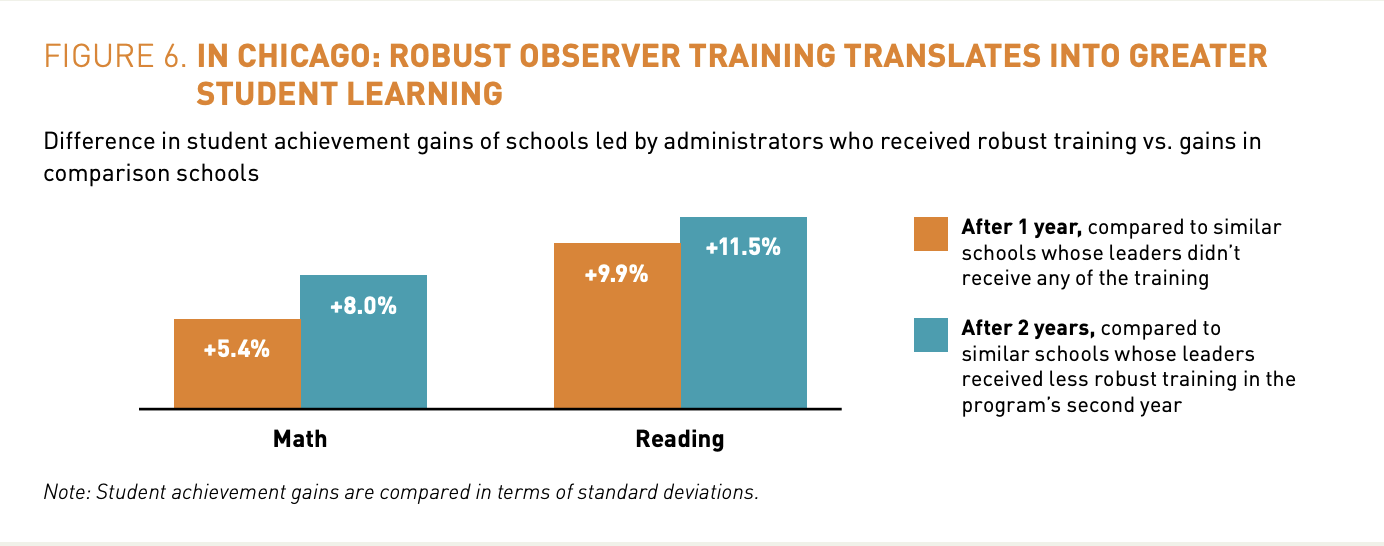
Source: Gates Foundation
To drive meaningful growth, observers need clarity on the goals of a lesson, a standardized classroom observation rubric, an eye for the right classroom evidence, and the ability to turn that evidence into high-quality feedback and actionable next steps.
In this classroom observation checklist, we break down key leadership actions for before, during, and after an observation—equipping instructional leaders to maximize the impact of coaching cycles for teachers and students.
Before: How to prepare for classroom observations
Effective observations begin with intentional pre-work. Before stepping into a classroom, observers should review the day’s lesson to build clarity on learning goals, student work, and teacher moves. Understanding the context they’re walking into provides a fuller picture, ensuring they can collect useful data and give targeted feedback that helps teachers support student mastery.
Ahead of a classroom visit, follow these three steps to effectively preview the lesson:
1. Clarify the learning goal.
- Look for: A clear learning target, aligned to grade-level standards
- Answer: What are students supposed to learn by the end of the lesson?
2. Anticipate the student experience.
- Look for: The high-stakes moments in the lesson—where the rigor lives, where students are most likely to struggle, and where the lesson bridges from mini-lesson to independent practice
- Answer: Where is the most likely point of error for students in this task, and how is the lesson structured to address it?
3. Identify how progress will be measured.
- Look for: Checks for understanding, opportunities for feedback, assessment of progress
- Answer: How will the teacher know if students are getting it? How will students know?
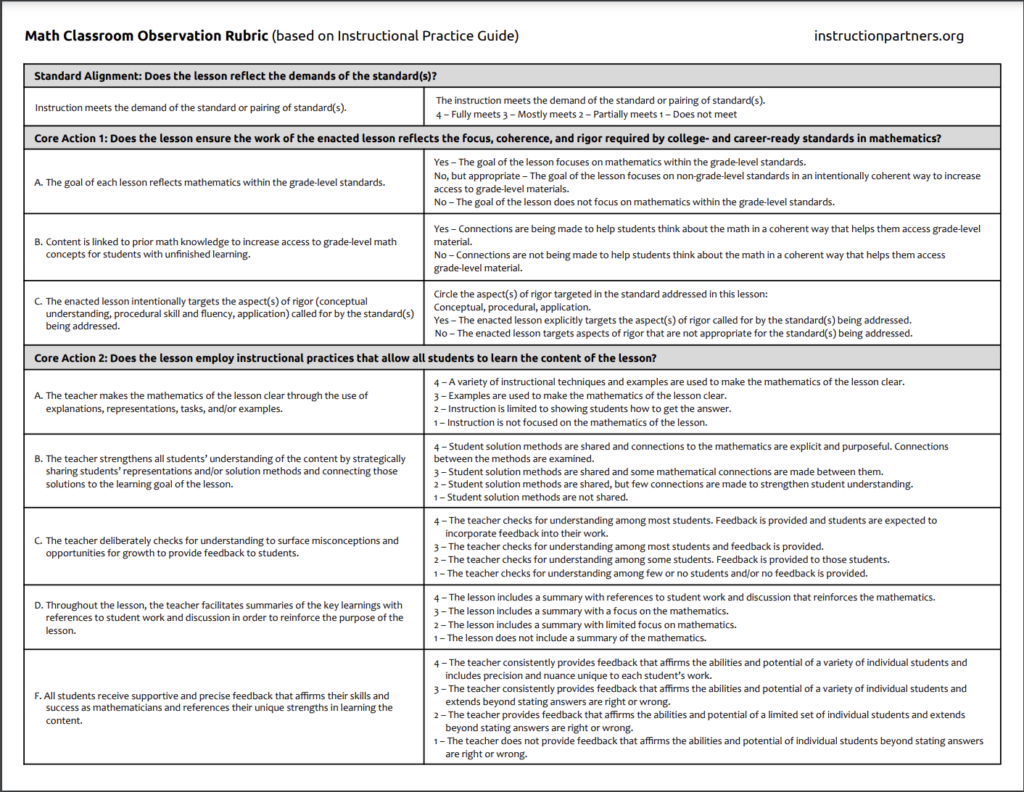
Download our free classroom observation tools
The Instructional Practice Guides are classroom observation tools that describe “core actions” associated with standards-aligned content, effective teaching, and meaningful student engagement in ELA, reading foundational skills, math, and science. Each core action includes indicators and a rating scale, making it easy to identify trends across classrooms and track progress over time.
more
During: How to maximize your time in the room
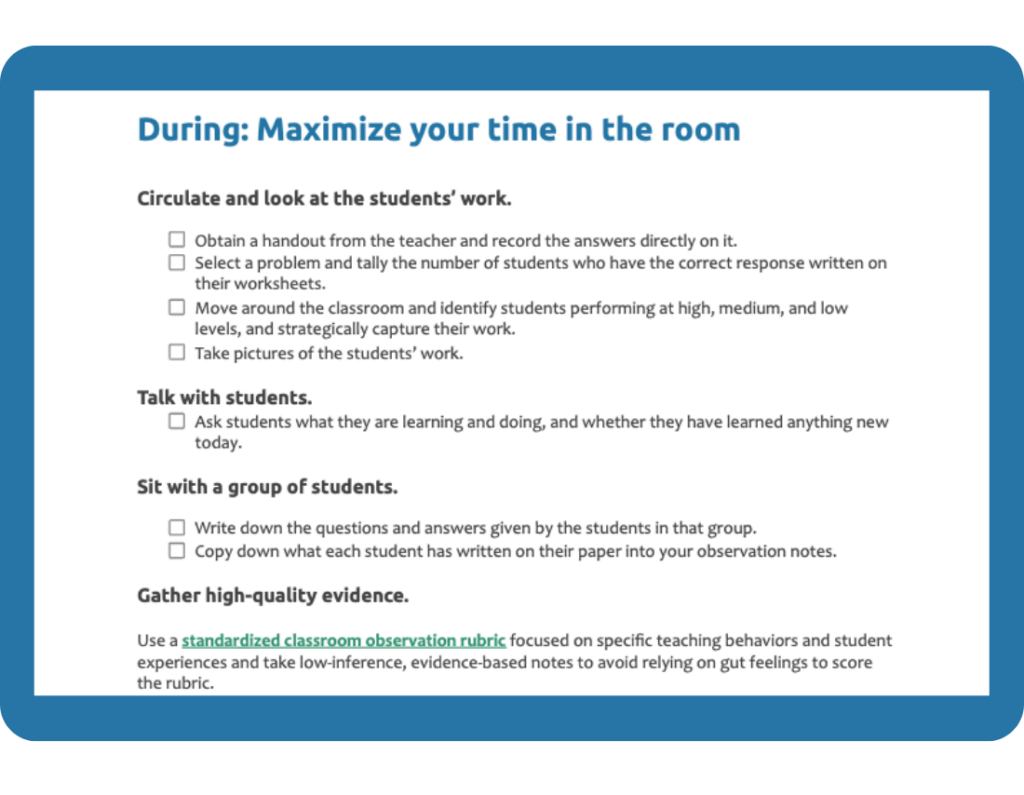
Plan to observe instruction for at least 15 minutes to capture trends. Circulate, talk with students about what they are learning and why, and take photos of student work to ground your upcoming coaching conversation in reality.
Circulate and look at the students’ work.
- Obtain a handout from the teacher and record the answers directly on it.
- Select a problem and tally the number of students who have the correct response written on their worksheets.
- Move around the classroom and identify students performing at high, medium, and low levels, and strategically capture their work.
- Take pictures of the students’ work.
Talk with students.
- Ask students what they are learning and doing, and whether they have learned anything new today.
Sit with a group of students.
- Write down the questions and answers given by the students in that group.
- Copy down what each student has written on their paper into your observation notes.
Gather high-quality evidence.
High-quality data is the foundation of high-quality coaching. Use a standardized classroom observation rubric focused on specific teaching behaviors and student experiences and take low-inference, evidence-based notes to avoid relying on gut feelings to score the rubric.
Collect varied observational evidence, including:
- Verbatim dialogue: Direct quotes from both the teacher and the students
- Visual artifacts: What is written on the board, on handouts, or in student notebooks
- Material usage: Descriptions of the materials and how they are used
- Quantitative data: Tallies of specific behaviors (e.g., how many students share their work; how many tasks explicitly direct students to use text evidence in ELA; how many different models and strategies are used to represent the work of the lesson in math)
- Lesson flow: Time transitions, sections of the lesson, work time, etc. to reconstruct the flow of the lesson
- Student ownership: Explicit evidence of what students know and are able to do, noting who has the teacher’s attention (and who might be flying under the radar)
After: How to prepare actionable feedback
A great observation identifies a problem; a great coach identifies a solution that the teacher can master quickly. When a leader enters the classroom with clarity and leaves with objective data, they have exactly what’s needed to identify both.
Following a classroom observation, leaders should plan to:
- Support the teacher in identifying what needs to be adjusted.
- Support the teacher in identifying how to make the adjustment.
- Draft the action step in a clear, concise way.
The following guiding questions can support in this preparation:
- Highest-leverage fix: Of all the gaps I saw, which one—if fixed—would most quickly increase the rigor of the tasks?
- Continuity check: Does this adjustment build on a previous success and/or directly address a persistent challenge we’ve been working on?
- Action step check: Is this step bite-sized? Can the teacher implement this tomorrow, or is it too vague (e.g., “increase engagement” vs. “use a 30-second turn-and-talk after the check for understanding”)?
- Student evidence marker: Exactly what will I see in the classroom next week if this action step is successful? What is the look-for for mastery?
Ready to put this into practice?
Use the questions and strategies above to strengthen your next classroom observations—download the checklist to get started.
Follow along
The next post in this series will break down how to facilitate a collaborative coaching meeting that turns observations into real teacher growth—subscribe to our mailing list to have it delivered straight to your inbox.