
Scaffolding (Without Overscaffolding) for Multilingual Learners in Math
Companion resource
Download our free guide, Scaffolding UP for Multilingual Learners: A Guide to Responsive, Integrated Content and Language Learning for Math Instruction, to put the strategies explored below into practice.
By Dr. Jessica Costa, Dr. Paola Mendizábal, Miaisha Bannister, Cyndia Acker-Ramirez
Supporting multilingual learners in math class requires a delicate balance: providing enough guidance to ensure access without inadvertently removing the productive struggle necessary for deep learning. Consider two examples of how a middle school teacher might present the two-step equation: 4x + 6 = 26.
Example 1
The teacher:
- shares a few different two-step equations, outlines the steps, and asks students to pair up and share what they notice and wonder;
- uses student responses to affirm aligned thinking and language;
- promotes deeper reasoning and language with prompts such as, “Can you tell me more?” or “Is there another way we can think about that?”; and
- refers to supports in the room and/or uses additional supports to remove linguistic barriers when appropriate.
Example 2
The teacher:
- provides a more accessible one-step equation to solve (x – 2 = 7);
- introduces the two-step equation strictly as a procedural algorithm, without reference to understanding of the variable or the properties of equality;
- starts with a think aloud and walks students through each step;
- asks only questions around the computation (e.g., “What is 26 minus 6?” or “What operation do I do next?”) rather than questioning the relationship between the terms or what the solution means; and
- gives answers to avoid frustration when students need additional support.
Example 1 is clearly more representative of the type of scaffolding that students should receive—the teacher provides support, but ensures at every step that students maintain the cognitive lift required to engage with the grade-level content.
By contrast, example 2 also features teacher support—but provided in a way that is likely to undermine grade-level thinking, rather than make it more accessible. Unfortunately, we often see scaffolding that looks much more like example 2 when teachers are supporting multilingual learners (MLs).
When MLs don’t automatically “get” grade-level math concepts or when they have trouble expressing their reasoning, a teacher’s instinct may be to step in and steer them toward success. However, too often, this well-intentioned support becomes watered-down instruction.
Teachers come by these habits honestly and unintentionally—few receive specific training on how to help students understand math concepts while helping them master a new language.
For students who are on the journey to full English proficiency, math instruction can present some unique challenges: mastering rigorous, grade-level math skills while learning to speak, understand, read, and write in a new language, including subject-specific vocabulary, symbolic notation, and concepts that are often difficult for students to understand even in their primary language—layered on top of dense word problems and multistep reasoning. However, when we remove too much friction from the process of building mathematical reasoning, we can deprive MLs of the opportunity to engage in deep math learning, which is associated with important long-term outcomes.
In this blog post, we explore how to avoid the trap of overscaffolding and ensure the supports you’re providing to MLs are appropriate, responsive, and—most importantly—actually help students develop deeper conceptual understanding while learning to express their reasoning and strategies like a mathematician in their new language.
Overscaffolding
Overscaffolding occurs when support becomes excessive (e.g., deeper support than is necessary, support that is too long-lasting). When we over-support, we unintentionally remove the productive struggle that students need to learn—and get in the way of their success.
Research shows that many educators assign MLs who have beginning English proficiency less challenging work than other students. However, even when MLs haven’t yet achieved full English proficiency, as we wrote back in 2023, “that doesn’t mean that they are any less capable of mastering grade-level content—if their teachers and administrators understand their linguistic development journey and are able to scaffold the right supports at the right time.” But, scaffolding the right supports at the right time can be a tricky balancing act. How do you know if your scaffolds are meeting the moment, or preventing a student from building problem-solving skills, strategies, and confidence in math?
Look for these red flags:
- Limiting student thinking: If the teacher is doing most of the talking or thinking, that’s a good indication that they’re overscaffolding. This might look like: After working on a problem, the teacher immediately explains the steps and the answer, rather than prompting students to make their own connections about why a strategy works or what the problem is asking. The teacher provides answers to questions directly, so all students have to do is copy or repeat the procedure, rather than demonstrate understanding on their own. The teacher “rounds up” responses—that is, when a student gives a partial answer, the teacher finishes the reasoning or makes the connection for them, instead of pushing the student to give more details (e.g., “And how do you know that 3/4 is the same as 75/100?”). The student misses the chance to build their own academic language and share their conceptual mathematical reasoning.
- Oversupporting: The teacher uses high-intensity supports (e.g., think-aloud to fully solve problems) when lighter supports (e.g., notice and wonder with models and representations) would suffice.
- Overtranslating: When MLs can read in their home languages, the teacher heavily translates word problems or all task directions, inadvertently removing the “productive struggle” required to develop English proficiency for math content. Home language support is a powerful tool; however, overusing translation can create a “translation dependency” where the student “tunes out” English because they know the version they already understand is coming. This could look like the teacher translating every term in a word problem, when they could instead use multimodal supports (e.g., diagrams, gestures, manipulatives) and reserve translation for genuinely abstract concepts that are difficult to represent any other way (e.g., imaginary numbers).
- Excessive frontloading: The teacher spends an excessive amount of time frontloading background knowledge or pre-teaching vocabulary in isolation rather than allowing students to encounter and make meaning of terms within the context of the problem or task. Though previewing vocabulary can be an effective strategy in moderation, when overused it can minimize—or even outright eliminate—the need for students to make sense of a problem themselves, which is a necessary component of most grade-level standards. For example, when learning about elapsed time, a teacher could start the lesson with direct vocabulary instruction on “elapsed time” and “intervals.” Or, to better support both access to language and content, the teacher could present students with a real-life scenario (e.g., a trip or movie length) and ask students a question in terms more familiar to them (e.g., “How much time passed?” or “How long was the trip/movie?” and then add on “You just found the elapsed time, which is the total time that passed between the start and end times. That is what we are going to be learning more about today”).
Responsive scaffolding
Responsive scaffolding is about responding to the variety of students’ strengths and needs in a class. This includes identifying specific barriers—whether they are linguistic, conceptual, or related to cultural background knowledge a lesson assumes students bring. It isn’t about making the work easier; it’s about providing the right tools so the student can do the heavy lifting. (One way to think about responsive scaffolding is through the lens of “Universal Design for Learning” principles [CAST], which focuses on varying access points to help all students work toward increasing rigor—not by simplifying the goal.)
When internalizing lessons, teachers (ideally collaboratively) should analyze the content and language demands of the specific lesson they’ll be teaching:
- What content knowledge does the lesson assume students bring (e.g., number sense, knowledge of connections between operations)?
- What are language demands embedded in the lesson (e.g., sequence language for retelling steps, justification connectors such as “because” and “since” when describing reasoning)?
- What are student assets related to this lesson (e.g., cognates for vocabulary, skills from prior lessons, topics/themes students find engaging such as soccer or cooking, conceptual knowledge from experiences—familiarity with the metric system could help students learn the imperial system, or experience splitting a bill or following a recipe could anchor work with fractions and ratios)?
Only then, after considering both the demands and the knowledge and skills they already have, can a teacher effectively plan appropriate scaffolds. For multilingual learners (MLs), productive scaffolding often means making language visible and explicit. Making the implicit structures of mathematical communication (e.g., vocabulary, sentence structure, and how word problems are organized) explicit both 1) makes learning those structures much more effective and 2) helps MLs connect with the mathematics being communicated because they’re not doing double duty trying to intuit the structures.
Providing targeted language supports that integrate the content:
- Use word or phrase banks for terms that serve particular functions that students can use in responses to curriculum-based questions. For example:
- words of sequence or justification (e.g., for sequence: “first,” “to start”; for justifying: “because,” “since”) or
- technical terms about the content topic (e.g., “operations,” “equals,” “percent,” “formula,” “inverse,” “origin”).
- Provide sentence stems that integrate language functions and academic vocabulary related to the objective (e.g., “The ___ strategy is most efficient because ___.” “When solving for ‘x,’ we first need to ___”).
Note: These kinds of support can help students focus on articulating their conceptual understanding and reasoning rather than the structure of explaining their thoughts.
Using multimodal supports:
- Provide graphic supports that help students organize their thinking, such as:
- co-created anchor charts that include unit key vocabulary or formulas and
- graphic organizers for the steps to solve different kinds of problems or for tracking the elements of a word problem.
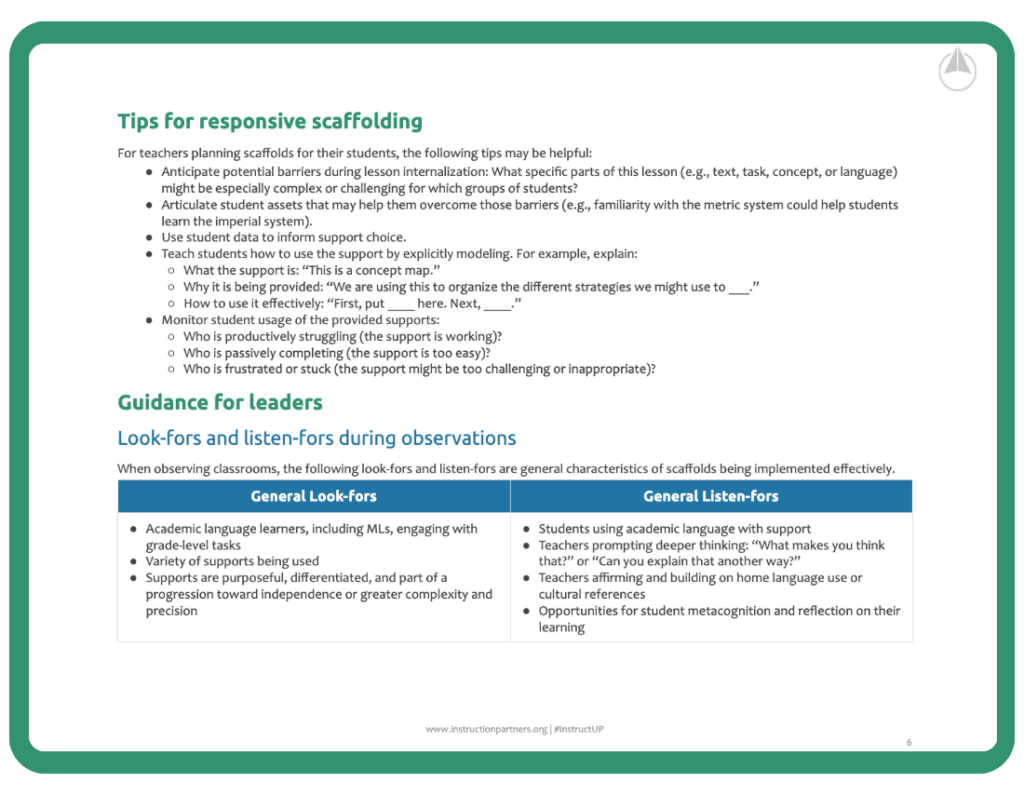
- Explicitly model how to use multimodal supports; for example, rather than just handing students a tool, like a graphic organizer, explain to them:
- what the support is: “This is a concept map”;
- why it is being provided: “We are using this to organize the different strategies we might use to solve this problem”; and
- how to use it effectively: “First, put ___ here. Next, ___.”
- Use sensory and visual means to reinforce key content, for example:
- show visuals or demonstrate with manipulatives (e.g., base ten blocks) to illustrate a concept;
- pass around objects related to the skill (e.g., tape measures or protractors before a measurement task); or
- show a short (e.g., 45-second) clip at the beginning of a lesson that builds on students’ background knowledge about the topic, embedding supports within videos to highlight key information or language as needed.
Note: Multimodal supports reinforce language learning for all students, not just MLs, by connecting new words and structures to images, actions, and experiences, making both the concept and the language more understandable and memorable.
Leveraging home languages:
- Encourage translanguaging (i.e., using all the languages a student knows) to brainstorm or share strategies before articulating their reasoning in English.
- Share cognates—words that look and sound similar across languages—to help students make immediate meaning of new vocabulary (e.g., “algebra” in English, “álgebra” in Spanish, “algèbre” in French).
Note: Using home languages can also be a helpful strategy with students who may speak a variety of English at home that has a set of vocabulary and grammatical rules that differ from Standard, sometimes called General, American English.
Leveraging personal connections:
- Ask students to make personal connections to the lesson’s topic (e.g., “Today we are going to practice using fractions—have you ever followed a recipe when cooking?”).
- Refer to prior knowledge—for example, make connections to a topic or skill previously taught (in the same or different unit or grade level).
- Ask students what they notice and wonder about a math representation or as they unpack a word problem.
Note: Like multimodal supports, using personal connections to reinforce new learning helps make content stickier for all students.
A Guide to Responsive, Integrated Content and Language Learning
If you want to dive deeper into responsive, discourse-driven scaffolding, download our resource, Scaffolding UP for Multilingual Learners in Math. The tool includes:
- Detailed observation indicators: A breakdown of expected classroom evidence.
- Scaffolding examples: Specific strategies and examples for utilizing linguistic, multimodal, and cross-linguistic (home language/translanguaging) supports.
- Guidance for school leaders: Targeted reflection stems designed for instructional coaches and school leadership teams to use during walkthroughs, PLCs, and instructional stepbacks.
The goal of any scaffold is to build independence with increasingly demanding and complex skills and problems, including moving students from their current language proficiency to a more advanced level. To be responsive to student growth needs, educators should consistently monitor how students are using the supports provided as well as monitor their thinking and language use to provide in-the-moment feedback to affirm or advance students toward the lesson’s goals.
In our experience, we find it’s helpful to consider three broad categories:
- Who is productively struggling (i.e., the support is working)?
- Who is passively completing (i.e., the support is making the work too easy)?
- Who is frustrated or stuck (i.e., the support might be too challenging or just not what they need)?
As MLs begin to internalize content and strategies—that is, move from productively struggling to passively completing—it’s time to adjust the scaffold so the work becomes more linguistically challenging (e.g., moving from a simple “I used ___ strategy because ___” stem to “Based on the information provided in the word problem, I decided ___ was the best strategy because ___”).
Effective scaffolding for MLs is rooted not only in their current level of English proficiency but in understanding the cognitive strengths, cultural funds of knowledge, and prior schooling they’ve had in their home language. By treating scaffolds as a bridge to rigorous, grade-level mathematics, we can hold high expectations for MLs, honor the assets they bring to the classroom, and support their learning without falling into the trap of deficit thinking—or overscaffolding.

Responsive scaffolding for multilingual learners in ELA
Looking for more resources for supporting MLs? Check out the ELA version of this blog for strategies and examples for helping MLs develop content knowledge and advanced language skills during reading instruction.
me
there