
Q&A: Preparing for Instructional Coaching Conversations
During a recent webinar, Christina Gonzalez, Director of ELA, answered instructional leaders’ questions about how to prepare for coaching conversations that lead to meaningful shifts in teacher practice.
We’ve compiled the highlights below, including insights on identifying next steps, delivering content-specific feedback, and navigating common barriers to feedback implementation.
These responses have been edited for brevity and clarity. You can access the full webinar recording here.
What coaching protocols do you recommend to move coaching conversations from simply analyzing student outcomes to making instructional decisions?
Instruction Partners does not endorse a particular coaching protocol. We help our partners and our school leaders find the protocol that works for them, their school, and who they are as people. But there are some things that are non-negotiable. We name the strength, and we pivot to build on that strength when we name the opportunity for improvement. But that’s not the end of the coaching conversation, right? We need the teacher to be able to practice that opportunity in a low-stakes environment, rather than live in front of students. That’s what we call rehearsals. So you definitely want to build rehearsal time into your protocol.
We also want the observer to give feedback on the rehearsal. Feedback could sound like, “I saw you practice that wait time, and I saw you practice preserving the productive struggle with the students. This time, try…” and you give the teacher a trickier situation or a different way to think about the instructional move that they’re practicing.
And the final thing that’s non-negotiable is providing next steps. Say something like, “The rehearsal was spot on for what we talked about. When can I come and see you do it live?” And then we can continue to build on that foundation.
What advice do you have for identifying a bite-sized, high-impact next step?
There are a few questions you can ask yourself to make sure the step is bite-sized and high-impact. Could the teacher implement the step this week? And then how is student learning going to improve in the next week? If your answer to the first question is no, or if you can’t answer the second question, you probably have a step that is not bite-sized enough. You should also consider whether the teacher can transfer this action step to other lessons or content areas, impacting student learning beyond just the next lesson. That’s what we’re looking for: something that is bite-sized, transferable, and high-impact.
And when I say bite-sized, I mean specific. Let me give you an example. If I say, “You need to use more of the text-dependent, higher-level questions that are named in the curriculum, because I see you only asking the literal level questions,” that feedback is not bite-sized enough. The teacher probably cannot do that tomorrow because she’s going to look at the curriculum and practice identifying the kind of questions I’m talking about. Instead, I could say, “Let’s look at tomorrow’s lesson. Let’s name which questions are the literal ones and which questions are the deeper, richer questions, and then let’s decide on two or three really rich questions you want to prioritize asking tomorrow.” That’s feedback that she can act on. She can prioritize three really rich questions for tomorrow. The more bite-sized and the more transferable the step, the more likely you are to see improvement in teaching and learning.
What would you say to leaders who think this step is too small or not rigorous enough?
We know from our experience with partners and from research that a small step actually implemented is infinitely more impactful than a big goal or a list of changes that the teacher eventually forgets about or just ignores. When coaches list too many action steps or the action steps are too broad, teachers can be overwhelmed, and then implementation usually falls apart. When the next step is a specific, manageable instructional move that the teacher can realistically implement in the next 48 hours, it’s much likelier that coaching feedback will make it into the classroom and you can continue building momentum.
How might we offer content-specific feedback, rather than general teaching moves?
Feedback needs to be anchored in the curriculum. A lot of teachers feel like they’re receiving general feedback, and there is going to be no improvement in teaching and learning if your feedback is general. When feedback is anchored in the curriculum, it helps ensure growth and ensure that next steps happen, and it gets teachers more invested. So, if you are a school leader who is observing ELA classrooms and that is outside your area of expertise, you have to commit to learning the curriculum that your teachers are using.
For example, if I tell you, “You need to think about more strategies for engagement,” that’s too vague and too broad. It’s not specific or actionable. But if I tell you, “Let’s look at some of the routines in ELA that support student engagement, and find one that you want to try out,” then we can dig into the ELA materials, and you can find a routine that feels natural for you and fits your students. And then you can try it out.
If feedback should be actionable within 48 hours, how can we coach for mindset shifts?
I think the question here isn’t how to coach for one or the other, but how to coach for both of them at the same time. For example, let’s say the mindset you want to shift is that “students can’t answer these questions.” My action step for that teacher might be: Let’s commit to asking one question tomorrow that you think is too challenging for students, and let’s think about one strategy you can use to reengage students if they can’t yet answer that question.
And if the teacher can do that tomorrow, the teacher can do that the next day, and they can do it the next day. Once they see a kid can do it with one question, can they do it with two questions? Can they do it with three questions? That’s why I think the bite-sized, high-leverage, transferable action step is so important—because that’s what makes it possible to coach both mindset and pedagogy at the same time. You can’t separate them; you have to coach for both at the same time.
What happens if the teacher doesn’t agree with the feedback?
When that happens, we need to diagnose the root cause before we can decide what the solution is. For example, a teacher might reject feedback because there is no psychological safety built in that conversation with the observer. (This blog post breaks down strategies coaches can use to build the trust and sense of safety required for meaningful growth.)
Another reason the teacher might reject the feedback is because they genuinely don’t agree with it, and that’s fair. We as observers are not perfect; we make mistakes, and it’s okay for a teacher to sometimes disagree with the feedback. And a teacher might disagree with the feedback because they don’t feel confident that they can successfully implement it, so rejecting the feedback feels safer than taking the risk of trying it. So I think we have to talk with the teacher to understand what the reason is for rejecting the feedback, because the three things that I just named would have very different pathways for how we can invest the teacher in the coaching conversation.
How should we approach coaching conversations when classroom management is the biggest barrier?
Sometimes there is a barrier to taking action on the action step, whether it’s classroom management or students not yet being able to read on grade level. When that happens, the first step is to trace the chain of evidence back to the root cause.
Let’s say the barrier is classroom management, where students are just talking to each other and they’re not listening to the teacher. When are the students talking? What is happening instructionally when the students are talking? What decision about instruction did the teacher make at that moment? What might be the root cause for why the classroom management is the issue at that moment? Then think about what planning decisions you could make with the teacher to start to alleviate some of those issues.
Now, let me also name: I coached first-year teachers for many years. It is not as easy as I am making it sound. I totally recognize that, but you’ve got to start somewhere. And when classroom management feels like it’s getting in the way of the instructional next step, figure out what it is about instruction that is resulting in the classroom management, and then make your decision from there.
Do you approach coaching strategy in the same way you approach lesson planning opportunities?
At Instruction Partners, we have two major avenues for driving instructional change. One is collaborative planning and one is coaching. But we know from doing the work that you can’t always separate the two. There are always going to be classroom observations, whether that observation is connected to a cycle of observations and feedback, or it’s time to work on it during collaborative planning. I’m going to take what I learned from those observations, and I’m going to bring that back to collaborative planning as an anchor for conversations with teachers.
So, the trend I’m seeing when I’m in classrooms might be that the teacher is asking and answering their own questions, meaning the teacher is carrying most of the cognitive lift. During our next collaborative planning meeting, when we open that lesson, I’m going to ask the teachers where the cognitive lift is for students in this lesson, and how we can make sure that we preserve the cognitive lift for the students and that we don’t take it from them. So absolutely, my next step during a coaching observation meeting is often going to be very similar to my next step in a collaborative planning meeting.
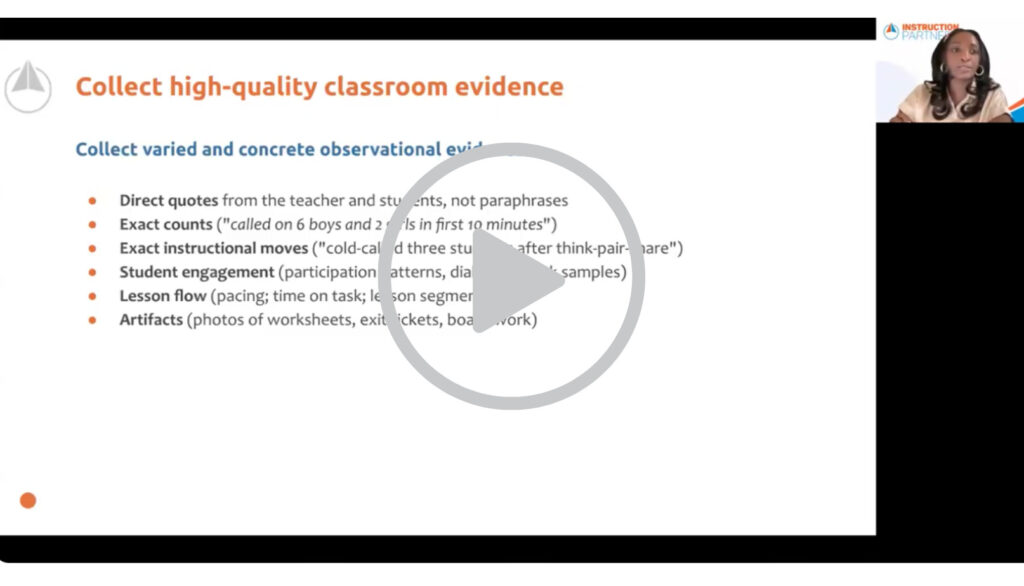
Watch the on-demand webinar
Watch the webinar recording for more ways to collect high-quality evidence during classroom observations and prepare for impactful coaching conversations.